


women practicing breathwork

The Quiet Power of Breathwork

You take roughly 22,000 breaths a day, mostly without a second thought. But when you shift from automatic breathing to intentional breathwork, you tap into a built-in control panel for your entire nervous system.

By actively engaging your diaphragm rather than taking shallow chest breaths, you send a direct, physical signal to your brain that you are safe, allowing your body to shift out of “fight or flight” mode.

Why It’s Worth Your Time

  • Lowers Stress Instantly: Slow, deep breathing stimulates the vagus nerve. This activates your parasympathetic nervous system, quickly dropping your heart rate and lowering cortisol levels.

  • Sharpens Focus: Techniques like “box breathing” optimize oxygen exchange and help clear mental fog. It’s exactly why elite athletes and first responders use breathwork before high-pressure situations.

  • Promotes Better Sleep: Extending your exhales (like breathing in for 4 seconds and out for 8) acts as a natural tranquilizer, making it much easier to transition into deep sleep.

  • Builds Emotional Resilience: Regular practice trains your body to recover faster from acute stressors, making daily frustrations feel far more manageable over time.

The best part? You don’t need a meditation cushion, a gym membership, or an hour of free time. Your breath is always with you, ready to be used as a tool whenever you need a reset.
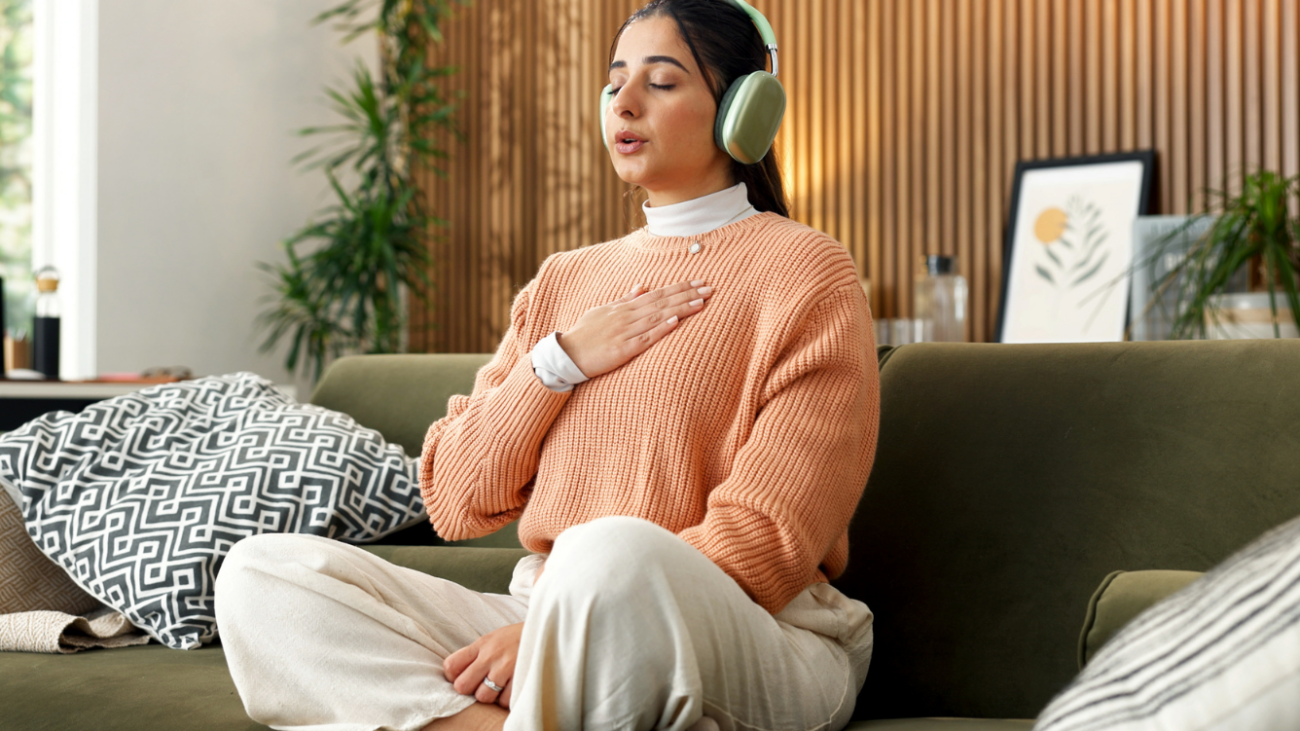
women listening to binaural beats

A Quick Guide to Binaural Beats

Have you ever put on a focus playlist and felt almost instantly “in the zone”? You might have been listening to binaural beats.

What are they?

A binaural beat is actually an auditory illusion. When you listen to two slightly different sound frequencies—one in each ear—your brain compensates for the difference by creating a third, pulsing “phantom” tone.

For example, if you hear a 400 Hz tone in your left ear and a 410 Hz tone in your right ear, your brain will perceive a pulsing beat at exactly 10 Hz. (Note: You must wear stereo headphones for this to work!).

Why do people use them?

The core theory relies on a concept called brainwave entrainment. The idea is that your actual brainwaves will begin to sync up with that phantom frequency, nudging you into specific mental states:

  • Delta (1-4 Hz): Deep sleep and physical healing.

  • Theta (4-8 Hz): Meditation, deep relaxation, and creativity.

  • Alpha (8-13 Hz): Calm, relaxed focus.

  • Beta (14-30 Hz): High-level concentration, alertness, and problem-solving.

The Verdict: Science or Placebo?

The clinical research on binaural beats is still mixed. Some studies show they genuinely help reduce anxiety and improve memory recall, while others argue the benefits might just be a very effective placebo.

However, they are completely safe, highly accessible, and totally free to try. The next time you need to study for an exam or wind down after a stressful day, grab your headphones, search for a track on your favorite streaming app, and see if your brain catches the rhythm.